Services
What Is 3D Printing Prototype?
3D Printing is a broad term used to describe additive manufacturing, which includes a series of rapid prototyping technologies that combine multiple layers of materials to create parts.Rapid prototyping 3D printing is the quick, easy and cost-effective way to turn great ideas into successful products. These 3D printing prototypes not only help to verify the design but also find issues early in the development process and feedback directly on design fix, preventing costly changes once the product is in full production.
Why Choose WayKen For 3D Printing Service?
WayKen is an expert in the field of rapid prototyping manufacturing in China, providing a wide range of 3D printing services, including SLA 3D printing (Stereolithography), SLS 3D printing (Selective Laser Sintering).At WayKen, We have a full team of dedicated engineers and project managers that will work with you to verify your CAD designs, product functions, dimensional tolerances, etc. As a professional prototype manufacturer, we deeply understand the prototype and production needs of any business. We strive to meet all specified times to deliver products with quality guarantees to our clients worldwide at affordable prices.
Benefits Of 3D Printing
Shorten Delivery Times. Parts can typically be shipped within a few days, speeding up design iterations and time to market.
Build Complex Geometry. Allows the creation of unique parts with more complex geometries and precise details without increasing costs.
Reduce Manufacturing Costs. Drive to reduce production costs by eliminating the need for tools and reducing labor.
What Is SLA 3D Printing?
JuMi is your reliable R&D partner. From a CAD design to a physical prototype in your hands, and finally to your team, it is faster than ever. We have developed the latest rapid prototyping technology to meet your design challenges, and will work with you to verify and improve your product ideas, functional testing, and engineering verification. Our rapid prototyping services include CNC prototyping, 3D printing, vacuum casting, rapid tooling, sheet metal prototyping, and prototype finishing.
How Does SLA 3D Printing Work?
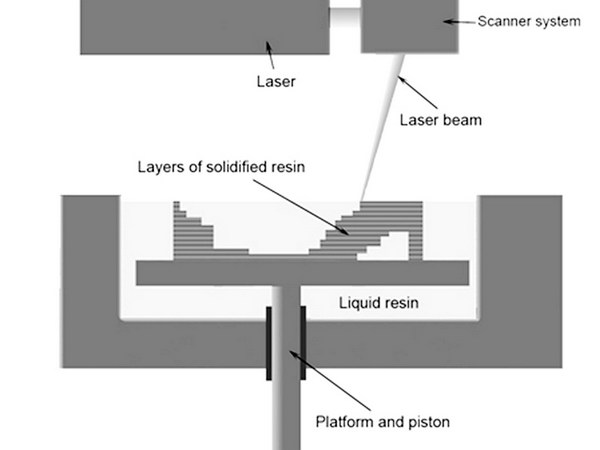
Data processing, the 3D Model is imported into a slicing program of proprietary software, with support structures added as necessary. The STL file is then sent to print on the SLA machine, with a tank filled with liquid photosensitive resin. A building platform is lowered into the tank. The UV laser beam focused through the lens scans contour of the cross-section along the liquid surface. The resin in the scanning area solidifies quickly to form a single layer of material. Once the first layer has been completed the platform is lowered by 0.05–0.15mm with a fresh layer of resin covering the build surface. The next layer is then traced out, curing and bonding the resin to the layer below. Then repeat this process until the part is built.
What Is SLS 3D Printing?
JuMi is your reliable R&D partner. From a CAD design to a physical prototype in your hands, and finally to your team, it is faster than ever. We have developed the latest rapid prototyping technology to meet your design challenges, and will work with you to verify and improve your product ideas, functional testing, and engineering verification. Our rapid prototyping services include CNC prototyping, 3D printing, vacuum casting, rapid tooling, sheet metal prototyping, and prototype finishing.
How Does SLA 3D Printing Work?
Data processing, the 3D Model is imported into a slicing program of proprietary software, with support structures added as necessary. The STL file is then sent to print on the SLA machine, with a tank filled with liquid photosensitive resin. A building platform is lowered into the tank. The UV laser beam focused through the lens scans contour of the cross-section along the liquid surface. The resin in the scanning area solidifies quickly to form a single layer of material. Once the first layer has been completed the platform is lowered by 0.05–0.15mm with a fresh layer of resin covering the build surface. The next layer is then traced out, curing and bonding the resin to the layer below. Then repeat this process until the part is built.
Advantages And Applications Of SLA & SLS
Advantages of SLA 3D Printing
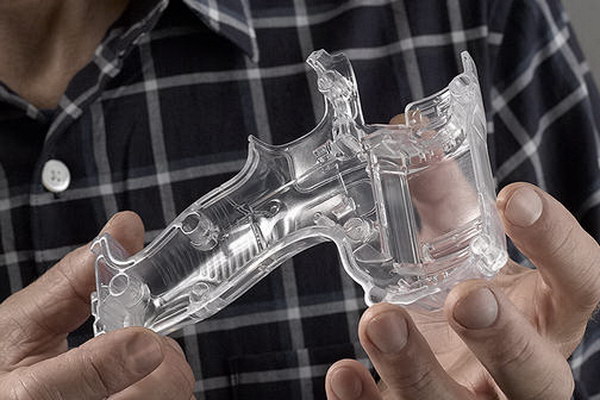
Lower layer thickness and higher accuracy. Complex shapes and precise details. Smooth surfaces and post-processing options. Various material property options.
Advantages of SLA 3D Printing
Lower layer thickness and higher accuracy. Complex shapes and precise details. Smooth surfaces and post-processing options. Various material property options.
Ready To Get Started?
Compare The Following Capabilities Of SLA And SLS To Choose The Right 3D Printing Service
Material Properties SLS 3D printing is rich in materials and can be made of plastic, metal, ceramic, or glass powders with good performance. JuMi machines can produce parts in white Nylon-12 PA650, PA 625-MF (Mineral Filled) or PA615-GF (Glass Filled). However, SLA 3D printing can only be a liquid photosensitive polymer, and its performance is not as good as thermoplastic plastic. Surface finish The surface of the prototype by SLS 3D printing is loose and rough, while SLA 3D printing provides high-definition to make the surface of the parts smoother and the details clearer. Glue Bonding Strength The SLS 3D printing binding strength is better than that of SLA 3D printing, for which there are many pores on the surface of SLS binding that contribute to the infiltration of viscose. Master Patterns SLA 3D printing is suitable for the reproduction of the prototype master pattern because it has a smooth surface, good dimensional stability, and fine features.
Material Properties SLS 3D printing is rich in materials and can be made of plastic, metal, ceramic, or glass powders with good performance. JuMi machines can produce parts in white Nylon-12 PA650, PA 625-MF (Mineral Filled) or PA615-GF (Glass Filled). However, SLA 3D printing can only be a liquid photosensitive polymer, and its performance is not as good as thermoplastic plastic. Surface finish The surface of the prototype by SLS 3D printing is loose and rough, while SLA 3D printing provides high-definition to make the surface of the parts smoother and the details clearer. Glue Bonding Strength The SLS 3D printing binding strength is better than that of SLA 3D printing, for which there are many pores on the surface of SLS binding that contribute to the infiltration of viscose. Master Patterns SLA 3D printing is suitable for the reproduction of the prototype master pattern because it has a smooth surface, good dimensional stability, and fine features.
Advantages And Applications Of SLA & SLS
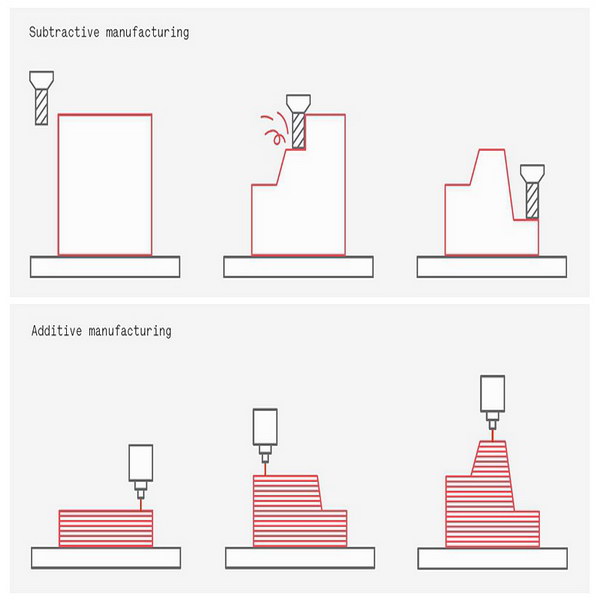
Subtractive & Additive Manufacturing 3D printing is also known as additive manufacturing, which builds parts through layers of materials. It has many advantages over traditional manufacturing processes however it has its problems. CNC machining is a fairly common subtractive technique used for parts manufacturing, which creates parts by cutting off the blank. Materials & Availability The 3D printing process involves parts being created layer by layer using materials such as liquid photopolymer resins (SLA), drops of photopolymer (PolyJet), plastic or metal powders (SLS/DMLS), and plastic filaments (FDM). So it produces less waste compared with CNC process. CNC machining is to cut from a whole piece of material, so the utilization rate of the material is relatively low. The advantage is that almost all materials can be CNC machined, including production-grade engineering plastics and various metal materials. This means that CNC machining may be the most viable technique for prototypes and end-use mass-produced parts that require high functionality and special performance.
Subtractive & Additive Manufacturing 3D printing is also known as additive manufacturing, which builds parts through layers of materials. It has many advantages over traditional manufacturing processes however it has its problems. CNC machining is a fairly common subtractive technique used for parts manufacturing, which creates parts by cutting off the blank. Materials & Availability The 3D printing process involves parts being created layer by layer using materials such as liquid photopolymer resins (SLA), drops of photopolymer (PolyJet), plastic or metal powders (SLS/DMLS), and plastic filaments (FDM). So it produces less waste compared with CNC process. CNC machining is to cut from a whole piece of material, so the utilization rate of the material is relatively low. The advantage is that almost all materials can be CNC machined, including production-grade engineering plastics and various metal materials. This means that CNC machining may be the most viable technique for prototypes and end-use mass-produced parts that require high functionality and special performance.
SUBSCRIBE

- C22-C23, Yingfeng Business Mansion, No. 1192, Zhongshan Road, Tianhe Dist., Guangzhou, Guangdong, China (Mainland)
- +86 15920465246
- Lolita@jisionparts.cn
PRODUCTS
INQUIRY